

South Godstone
A Village Under Threat

Transport Networks - A22
The A22 stategic highway is the officially recognised diversion route for M23 closures and puts pressure on a road that needs to stay free‑flowing. Adding around 2,000 extra daily journeys from the new development would intensify that pressure and create knock‑on effects for nearby communities.
Traffic flow on the A22 — As the designated diversion for any M23 incident or roadworks, the A22 must remain clear enough to handle sudden surges of motorway‑level traffic. Extra local traffic reduces that resilience.
Local congestion — South Godstone, Godstone, and the M25 Junction 6 roundabout (Already acknowledged as 3 times over capacity) would all experience heavier, slower traffic, especially at peak times.
Safety concerns — More vehicles on the A22 increase risks for pedestrians crossing the road, particularly in villages straddling main roads and where crossing points are already limited.
Air quality and noise — Higher traffic volumes would worsen pollution in villages that already sit close to major transport corridors.
Gatwick 2nd Runway - This is already planned for development and when opened, will inevitibly drasticly increase traffic on the A22 and Junction 6, M25.
Name
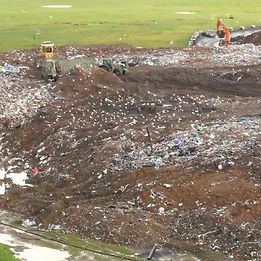
Environment - Landfill Land
Part of the land west of the A22 being a former landfill and is adjacent to the site is a material planning constraint, carries several implications that make it high‑risk and potentially unsuitable for development unless extensive remediation and engineering works are proven feasible.
Ground instability — Landfill sites often contain heterogeneous, decomposing waste. This leads to long‑term settlement, voids, and unpredictable ground movement. Foundations become complex, costly, and sometimes unviable.
Gas generation — Decomposing waste produces methane and carbon dioxide. Without engineered venting systems, this creates explosion and health risks for any buildings placed above or near the site.
Leachate contamination — Rainwater percolating through waste creates polluted leachate that can migrate into groundwater or nearby watercourses. Development increases the risk of disturbing containment layers.
Unknown fill materials — Older landfill sites often contain industrial waste, asbestos, heavy metals, and other contaminants. Excavation for utilities or foundations can expose hazardous material.
Environmental protection zones — Former landfill sites are frequently subject to regulatory controls, monitoring requirements, and restrictions on disturbance.
If the proposed development relies on land that is a former landfill, you can argue:
The site presents significant contamination and stability risks.
The burden of proof lies with the developer to demonstrate safety and viability.
Without robust evidence, the land cannot be considered developable.
Development could worsen existing drainage and sewer issues by disturbing capped waste or altering groundwater pathways.
Name

Environment - Sewage Capacity
Sewage flooding in South Godstone during heavy rain is consistent with the documented performance of the local network. Southern Water’s monitored data for the Godstone area shows repeated storm‑overflow discharges between 2021 and 2023, with 89 recorded spills lasting more than 770 hours. (Floodmapper.co.uk)
That level of spilling indicates a foul system already operating at or beyond its hydraulic capacity during rainfall. When a network is this stressed, intense rain drives groundwater and surface water into the sewers, causing them to surcharge and force diluted sewage out of manholes and into gardens.
A development that adds new foul flows to an already overloaded system increases the risk of:
More frequent storm‑overflow discharges into local watercourses
Sewer surcharging during heavy rain, leading to garden and property flooding
Greater pressure on Southern Water to upgrade infrastructure before allowing new connections
Southern Water’s own Drainage and Wastewater Management Plan identifies reducing storm‑overflow spills as a priority
Local evidence of flood impact: Residents in South Godstone have already reported flooding linked to heavy rain, inadequate enforcement of drainage responsibilities, and insufficient mitigation.
What this means for planning decisions: A development cannot rely on a sewer system that is already failing during rainfall. Planning authorities typically require:
A capacity assessment from the water company
Confirmation that upgrades will be delivered before occupation
Surface water attenuation and infiltration measures
Assurance that no additional load will worsen existing flooding
As the sewer is already surcharging into gardens, the current system does not have sufficient capacity for further development without infrastructure upgrades.
Name

Environment - Green Belt
The site is identified as an Area of Great Landscape Value (AGLV) and lies within the Green Belt, as shown in Figure 2: “Adapted Spatial Land‑Use and Policy Designations in Godstone Parish” of the Godstone Parish Neighbourhood Plan. These designations highlight the importance of the landscape, its visual character, and its contribution to the openness of the Green Belt.
Development on this land would therefore conflict with the Neighbourhood Plan’s objectives to protect valued landscapes and maintain the rural character of the parish. The AGLV status reinforces the need to conserve the area’s scenic quality, while the Green Belt designation requires that openness and permanence be preserved. Any development here would undermine these principles and run contrary to both local and national planning policy aims for landscape protection and Green Belt safeguarding.
Name

Environment - Biodiversity
Picture © Richard Jones
The site supports a diverse range of flora and fauna, including species that may be protected or locally endangered. Any development on this land would inevitably lead to habitat loss, fragmentation of ecological networks, and a measurable decline in biodiversity. This would be directly contrary to Tandridge Local Plan Policy NE1 (Biodiversity and Geological Conservation), which requires development to protect, enhance, and avoid harm to biodiversity assets.
Furthermore, the site forms part of a wider green infrastructure network that supports ecological connectivity across the district. Fragmenting this habitat would undermine the objectives of Policy NE2 (Green Infrastructure), which emphasises the need to maintain, enhance, and link natural habitats to support wildlife movement and long‑term ecological resilience.
Allowing development here would therefore conflict with the Local Plan’s environmental protection policies and broader sustainability goals, which prioritise safeguarding natural habitats and ensuring that development does not result in long‑term ecological degradation.
Name

Environment - Flooding
The land in question is highly prone to flooding, as demonstrated by previous flood events that have affected nearby properties and local infrastructure. Flood Risk Assessments have repeatedly identified this site as vulnerable to heavy rainfall and rising water levels. Developing in such a location would conflict with Tandridge Local Plan Policy CC4 (Flood Risk), which requires that new development must avoid areas at high risk of flooding and must not increase flood risk to people, property, or the wider area. Building on this site would clearly fail to meet these requirements and would expose future residents—and neighbouring properties—to unacceptable levels of risk.
In addition, the site provides an important habitat for local wildlife. Any development here would result in habitat loss, reduced biodiversity, and long‑term environmental harm. This directly conflicts with Policy NE1 (Biodiversity and Geological Conservation), which seeks to protect and enhance biodiversity, safeguard priority habitats, and ensure that development does not lead to ecological degradation. The site also contributes to the wider network of green spaces that support ecological connectivity, aligning with the aims of Policy NE2 (Green Infrastructure), which emphasises the importance of maintaining and strengthening green corridors and natural habitats.
Protecting this land is therefore essential not only for environmental reasons but also to ensure compliance with the Local Plan’s core principles on flood safety, biodiversity protection, and sustainable development.
Name

Sustainability
Sustainability
What does it mean?
The Key Pillars of Sustainability in Planning
1. Economic: Building strong economies by providing suitable land for growth,
innovation, and infrastructure.
2. Social: Fostering vibrant, healthy communities with diverse housing, safe
places, accessible services, and open spaces.
3. Environmental: Protecting and enhancing natural assets, managing
resources, reducing pollution, and adapting to climate change.
1. Is the development to be built on suitable land? This land is high quality green belt.
How can this be considered suitable land? The loss of farm land and harm to wildlife is
inevitable, can that be suitable? The village has no infrastructure in terms of doctor’s
surgeries, dental practices, any medical support structure. No Infant school, no nursery
school, No ambulance or fire station, no police station. What infrastructure?
It has a small station which is on the Redhill-Tonbridge line. Out of 961 it is ranked
732nd busiest. Out of a total of 2586 stations it is ranked the 1931st most used.
2. Is the development of South Godstone supporting safe places? The main Eastbourne
Road dissects both the village and proposed development, it is a busy road designated
as a relief road for the M25. The location of the development either side of the road is
close to an existing accident black spot, which will do nothing to make things safer. As
the village is devoid of services as seem in section 1 it cannot possible foster
accessible services. It will be destroying open space not fostering it.
3. The development will destroy natural assets in terms of greenbelt, farmland, wildlife
and make inaccessible historic areas yet to be fully investigated. Far from managing
resources and reducing pollution, it will be destroying them and by removing trees and
grassland, it will be increasing pollution and out carbon footprint. The result must
inevitably be, to add to climate change issue. some of the land under threat the A22 dissecting the development
The A22
The A22 footpath just north of the development looking south
The existing black spot just north of the development looking south
The development is totally unsustainable. Trying to fool people that it is not going to damage the environment of South Godstone, not going to destroy greenbelt, will not succeed.
Trying to say it is going to help the well-being of the villagers, attempting to explain it will not compromise future of generations to come, by increasing pollution and endangering lives on the roads, will not work.
Does this development offer the 5 C’s of sustainability!
Clean, Community, Culture, Care, and Corporate Governance
Answer; NONE OF THE ABOVE
Name

Green & blue infrastructure
Name
Transport Networks
Pressure on junctions and local access routes around South Godstone.
Name

Utilities
Name

Social infrastructure
GP and healthcare shortages, especially in rural districts
Name

Emergency services
Name

Green & blue infrastructure
How open the land looks from viewpoints.
The development blocks "unspoiled vistas," and therefore harms the visual dimension of the Green Belt.
Name

Green & blue infrastructure
Physical absence of built form & is a core test in NPPF.
500 houses represent a massive "volume" of built form where there is currently none. This is an absolute loss of spatial openness.
Name

Green & blue infrastructure
Change in views caused by development.
The proposed Development blocks long-distance views from public footpaths? It harms the visual dimension of the Green Belt by blocking "unspoiled vistas." .
Name

Green & blue infrastructure
Degraded or low‑quality Green Belt land, which may allow more flexibility, under new guidance is more suitable.
Argue that the site does strongly contribute to:
Purpose A (Sprawl): It acts as a vital barrier preventing the outward sprawl of the village into open countryside.
Purpose B (Coalescence): It prevents South Godstone from merging with nearby settlements like Blindley Heath or Godstone.
Purpose C (Encroachment): As active high-quality farmland or natural habitat, building here would be a "manifest encroachment" into the countryside.
Name

Green & blue infrastructure
Anything not listed as an exception; anything harming openness will be refused unless Very Special Circumstances outweigh harm. This is especially relevant if changes will be out of character in the area..
Under the National Planning Policy Framework (NPPF), Green Belt boundaries should only be altered in "exceptional circumstances." The applicant has failed to demonstrate the "Very Special Circumstances" required to outweigh the permanent harm this development would cause to the openness of the Green Belt
Name